Hiển thị các bài đăng có nhãn Language and Culture. Hiển thị tất cả bài đăng

TET VIETNAM

The increasing competition and burgeoning development needs in the first decades of the 21st century have dragged people into such a bustling and busy life. People sometimes concentrate too much on pursuing material temptations to understand and feel the true values of this life.

Fortunately, there always comes a time of the year which is slow and warm enough to make people temporarily forget their daily-life pressure. At this time, the rushing pace of life seems to be slower; and it is “Tet” occasion I would like to mention here. In many people’s mind,   the profound significances of “Tet”, together with all the traditions and customs attached to this occasion, are what make the soul of every Vietnamese warm-hearted  and make Vietnam truly Vietnamese.

Tet is a traditional occasion to celebrate the Lunar New Year, therefore Tet often happens between late January and early February according to Gregorian calendar. The preparations including redecorating houses; buying new clothes for children, necessary foods, cakes and candies, jams to welcome and celebrate Tet are indispensable activities and often range from two weeks to even a month.

Besides those preparations, making Chung cakes (sticky rice square cake) – a traditional custom held by generations of Vietnamese people since King Hung found the country - is considered as a completely important activity before Tet officially comes and a point of Vietnamese cuisine.  The beautiful and delicious “Chung” cakes are made of these ingredients: glutinous rice, pork, and green bean carefully wrapped in “Dong” leaves. To create the best “Chung” cakes, it is Vietnamese’s habit to cook them under the fire of wooden.  Family members and neighbors often assist each other in the process of making and cooking “Chung” cakes, which helps raises the fun and significances to the whole of “Tet” occasion.


Decorating the altar is also a beauty in the culture of TET. The altar is clearly cleaned and on the altar, Vietnamese people often put a pair of “Chung” cake; vases of peach, apricot and typical flowers of the weather when “TET” and spring comes like daisies, lilies, gerberas; the colorful boxes of cakes, candies and jam; and fruit tray with 5 different fruits depending on every region and ethnic.


The word "Five" in "five-fruit-tray" expresses for five basic elements called “Metal” – “Plant” – “Water” – “Fire” and “Land” respectively. These five factors are said to have constituted the universe in the concept of Confucianism. Commonly, Vietnamese people use 5 fruits with 5 different colors to arrange the five-fruit-tray such as a bunch of green bananas, persimmons, tangerine, grapefruit (which can be replaced by papaya) and apples. A bunch of green bananas symbolizes for the images of hands spreading out to seize success. Similarly, luck is represented by the persimmons or tangerines. Happiness is characterized by a succulent grapefruit; the sufficiency is hidden in the papaya while apple is a symbol of prosperity.

New Year’s Eve - when everyone returns home to enjoy Tet with their cherished family and relatives, is a time for reunion. People, both the young and the old, make resolutions for themselves to carry out during the New Year. These resolutions can vary from trivial things such as breaking themselves of a negative habit to more ambitious ones like getting promotions in career. When the 0:00 o’clock bell rang, people give their beloved ones the dearest wishes, enjoy the firework performance together, and expect a promising and glorious year for themselves and their family.

On the first day of Tet, activities usually start late. Family members gather together for the first meal of the New Year. The traditional dishes imbued with Vietnamese identity - the symbols of good luck and success such as “Chung” cake, glass noodles, chicken, pickled onions and jellied pork are elaborately prepared and excellently cooked, contributing remarkably to the significance of “TET”. People also visit pagodas to pray for a healthy, peaceful, happy, wealthy and prosperousyear for the entire family.

An additional feature that amounts to the uniqueness of Tet is the custom of asking for lucky words, sentences or sincere wishes. Old calligraphists often give passers-by meaningful words, sentences or wishes written in black ink on crimson paper. It is widely acknowledged that hanging that extraordinary kind of art form at home will bring the family luck and peace in the New Year.

In Vietnamese people’ mind, TET is an occasion for family reunion, visiting relatives, teachers and friends after such a busy year that we spend just little time for each other. Therefore, Tet is a chance to narrow the gap among people and connect people together. People send each other the best wishes. Adult award children the red envelopes with lucky money inside them and children cross their arms, bowed their heads and say “Thank you” before spreading their pretty lovely little hands to receive the first buds from adults.

TET is considered as one of the happiest and most important time of the year, which helps increase the attractiveness of Vietnamese culture. Therefore, people all try to forget all their sadness to comfortably enjoy their TET holiday with their family and their friends. 

Readers' stories, An Old Guy and a Bucket of Shrimp

This is a wonderful story and it is true. You will be glad that you read it, and I hope you will pass it on.
It happened every Friday evening, almost without fail, when the sun resembled a giant orange and was starting to dip into the blue ocean.  Old Ed came strolling along the beach to his favorite pier.  Clutched in his bony hand was a bucket of shrimp. Ed walks out to the end of the pier, where it seems he almost has the world to himself. The glow of the sun is a golden bronze now.  Everybody's gone, except for a few joggers on the beach. Standing out on the end of the pier, Ed is alone with his thoughts...and his bucket of shrimp.
Before long, however, he is no longer alone. Up in the sky a thousand white dots come screeching and squawking, winging their way toward that lanky frame standing there on the end of the pier.  Before long, dozens of seagulls have enveloped him, their wings fluttering and flapping wildly. Ed stands there tossing shrimp to the hungry birds. As he does, if you listen closely, you can hear him say with a smile, 'Thank you. Thank you.’  In a few short minutes the bucket is empty. But Ed doesn't leave. He stands there lost in thought, as though transported to another time and place.
When he finally turns around and begins to walk back toward the beach, a few of the birds hop along the pier with him until he gets to the stairs, and then they, too, fly away. And old Ed quietly makes his way down to the end of the beach and on home.  If you were sitting there on the pier with your fishing line in the water, Ed might seem like  'a funny old duck,' as my dad used to say. Or, to onlookers, he's just another old codger, lost in his own weird world, feeding the seagulls with a bucket full of shrimp.

To the onlooker, rituals can look either very strange or very empty. They can seem altogether unimportant …..maybe even a lot of nonsense.  Old folks often do strange things, at least in the eyes of Boomers and Busters.  Most of them would probably write Old Ed off, down there in Florida ... That's too bad. They'd do well to know him better.
His full name:  Eddie Rickenbacker. He was a famous hero in World War I, and then he was  in WWII. On one of his flying missions across the Pacific, he and his seven-member crew went down. Miraculously, all of the men survived, crawled out of their plane, and climbed into a life raft.  Captain Rickenbacker and his crew floated for days on the rough waters of the Pacific. They fought the sun. They fought sharks. Most of all, they fought hunger and thirst. By the eighth day their rations ran out. No food. No water. They were hundreds of miles from land and no one knew where they were or even if they were alive.  Every day across America millions wondered and prayed that Eddie Rickenbacker might somehow be found alive.
The men adrift needed a miracle. That afternoon they had a simple devotional service and prayed for a miracle.  They tried to nap. Eddie leaned back and pulled his military cap over his nose. Time dragged on. All he could hear was the slap of the waves against the raft...suddenly Eddie felt something land on the top of his cap. It was a seagull!
Old Ed would later describe how he sat perfectly still, planning his next move. With a flash of his hand and a squawk from the gull, he managed to grab it and wring its neck. He tore the feathers off, and he and his starving crew made a meal of it - a very slight meal for eight men. Then they used the intestines for bait. With it, they caught fish, which gave them food and more bait....and the cycle continued. With that simple survival  technique, they were able to endure the rigors of the sea until they were  found and rescued after 24 days at sea.
Eddie Rickenbacker lived many years beyond that ordeal, but he never forgot the sacrifice of that first life-saving seagull... And he never stopped saying, 'Thank you.' That's why almost every Friday night he would walk to the end of the pier with a bucket full of shrimp and a heart full of gratitude.
Reference: (Max Lucado, "In The Eye of the Storm", pp...221, 225-226)
PS: Eddie Rickenbacker was the founder of Eastern Airlines. Before WWI he was race car driver. In WWI he was a pilot and became America's first ace. In WWII he was an instructor and military adviser, and he flew missions with the combat pilots. Eddie Rickenbacker is a true American hero. And now you know another story about the trials and sacrifices that brave men have endured for your freedom.
As you can see, I chose to pass it on. It is a great story that many don't know...You've got to be careful with old guys, you just never know what they have done during their lifetime.
(Shared by Evangeline Eliott, a neighbor of Dr. M. Sakaguchi, a retired educator)

Unknown things about April Fool’s Day!

April Fool's Day (1/4), also known as the Lying Day, is a funny and attractive festival, to those who are mischievous and funny. April Fool's Day has been becoming more and more popular in many countries around the world.

  1. The origin of April Fool's Day
According to experts on urban legends, most people believe that April Fool's Day has appeared since The Gregory XIII offered system to calculate solar calendar like nowadays.
France is considered to be the homeland of April Fool's Day. In 1562, Gregory XIII (1502-1585) decided to change the first day of the New Year which used to be stipulated on the 1st of April into the 1st of January.
However, due to backward means of communications at that time when news was spread out mainly by running, it was not until several years after the news of changing solar calendar was officially published that many could update the news.
And even when some people knew about the solar calendar change, they did not accept the new calendar system and continued to celebrate the New Year on the first of April.  As a result, this toughness was considered to be "silly" and became a laughing stock for everyone.
And others knowing this story jokingly called the April, 1st was The Lying Day". Since then, the name "April Fool’s Day" or “Lying Day " has appeared officially.
Even though this story seems to be very logical and credible, it remains to be seen as a hypothesis due to its lack of historical evidence and its only absolute basing on conjecture of historians. The accurate origin of "April Fools" remains a mystery of history.
Though April Fool’s Day is not an official holiday, it is held in many countries every year to celebrate on April, 1st by spreading rumors, telling lies or joking about a variety of topics to make fun or tease someone.
  1. The other names of April Fool's Day
April Fool's Day started from France and spread to other countries with many interesting names. This day was called "Poisson d'Avril" (April Fools) and April Fool in France and in the UK respectively.
In France, "April Fools" was known as Poisson d'Avril, (April Fool's Day), which is also the origin of Vietnamese name of this day. On this day, French children often cut pieces of paper to make the fish-shaped ones and flatten them against the classmate’s back secretly and then shouted "Poisson d’Avril!!!" (April Fool!!!) when those unlucky people realized the joke.
In Scotland, the name of April, 1st day coincided with the name of a species of cuckoo - April "Gowks". The name of April Fool's Day here was based on the game of trying to sneak a a fish made of paper on the back of the "victim" without being detected.
Around the world, it can be easily seen that several other countries have some traditional holidays which are similar to the day of this hoax.
The ancient Romans used to have a holiday called Hilaria to honor the God Attis. The name Hilaria sounds very similar to hilarity (fun) in English. Until now, Hilaria ceremony was has still been kept partly under the name "Roman Laughing Day".
Some non-Western countries also have similar traditions to the day "April Fool" on their own.
In Persia, there was is also a holiday with a similar theme, known as Sizdahbedar. On this day, which usually coincides with the April 1st, the Iranians also tease each other with hilarious hoaxes.
ca-thang-tu-3_1
  1. Time for lies on April Fool's Day
It is free for everyone to tell lies and the words of boast together on April 1st. However, your lies will not be forgiven in case you tell a lie at an inappropriate time
You can lie all day in the US, France, Ireland ... but just tell a lie till the noon of April 1st in the UK, Canada, New Zealand, and Australia.
  1. The best quote about April Fool's Day
Mark Twain – a famous American novelist made a very interesting comment about April Fool's Day: “The first day of April helps us understand clearly the quality of ourselves during the rest 364 days.”
  1. Children are the most important on April Fool's Day in Flemish (Belgian)
According to the Flemish tradition, on the April Fool's Day children are allowed to confine teachers and parents in the room and make the request of exchange.
Translated by Huong Hoang
Proofread by ELTiCenter

Some taboo things kept off by Vietnamese people in the New Year

TET (an occasion during the first days of the year) is an expression used to denote “THE NEW YEAR” of Vietnamese people according to Lunar Calendar. According to many Vietnamese people, what happening during TET decides all happening during that year. It means, the first days with a lot of luck and happiness will bring everyone a happy, lucky and successful year. Therefore, so as to prevent the bad things, Vietnamese people always try to avoid some taboo things listed as follow:


1. Funeral
The first day of the year is considered to be a time when all people in a country contribute for the happiness of the whole nation. Therefore, if any families unluckily have someone who passes away, they should not organize a funeral. However, they should prepare everything already to hold a funeral on the second day of the year. To families whose member has died in the previous year, they should not visit any other families to avoid bringing the bad things to them. In contrast, other families will visit the family who are in mourning to console and help ease their pain of losing their family member.
2. Sweeping house
According to people in the past, sweeping the floor of the house on the first days of the year is to sweep out all the good fortune, which is supposed to leads a poor year. Besides, it is believed that if people collect the rubbish in the house and throw them, the God of Wealth will leave the house. Therefore, it is common that people sweep the floor of the house, but not bring the rubbish out of the house on TET. And members of the family normally tidy up their house and put the furniture in order cleanly on the last days of the year to welcome the New Year.
3. Talk
The speech spoken on the first days of the year is said to affect what happens all the year. Therefore, instead of mentioning unlucky words, people are advised to talk to everyone by pleasant and happy words to bring joyfulness to not only themselves but also other people.
4. Dishes
On TET occasion, there are many dishes that Vietnamese people avoid eating. For instance, duck meat should not be eaten on the first month of the year because eating duck is mentioned to be a thing that will bring the bad luck. Besides, in some areas, people do not eat “shrimp” to avoid moving backwards like shrimp. Moreover, it is also people’ opinion that eating shrimp on TET is a sign of a slow, not developed year.
  1. Costumes
People prefer colorful clothes to white ones on TET. People keep off white clothes because white is believed to be the color of funeral and death. Therefore, costumes in red, pink and green are used commonly on TET, These colors will bring people a lot of happiness and joyfulness.
  1. Water and fire
Red fire has the meaning of the luck that a family will have in the next months of that year. Therefore, people are advised to refuse to give fire when being asked for fire. Giving fire to others on TET will bring the bad luck for a family like loss-making, internal frictions, having unlucky things when going out. Similarly, people also avoid asking other people for fire. In addition, people should not give water to others, according to a folk speech with the meaning that money will go into people’s pocket like water. Giving water to others is supposed to lead to the loss of good fortune.
  1. First-foot
Being the first New Year’s caller of a house on the first day of the year is a long-standing habit of Vietnamese. If the age of the first caller on New Year’s Day is suitable with a family, or he or she is a person who is always in luck in his or her life, that family will meet with good fortune in the New Year. Therefore, people whose age is not suitable with the master of the house should not be the first caller on New Year’s Day. Similarly, people who are in mourning should not be also the first New Year’s caller to avoid bringing unfortunate things to others.
  1. Breaking things
In ancestors’ opinion, breaking things is supposed to be a sign of separation and sorrow. It is a bad omen for every family in the New Year. Therefore, people are advised to be careful with furniture in their house so that there will be no quarrels or sad news happening in that year.

9. Borrowing money
During the first days of the year, if people borrow money, they will have a year with a poor finance. Therefore, people do not often borrow money from others on TET.
Every ethnic and area has its own customs and habits; but the things mentioned above are the most common forbidden ones that Vietnamese people avoid during the first days of the year to have a happy and successful year.
How about customs in your countries in the New Year? Let share with us and send to our email: elticenter.hiep@gmail.com
By ELTiCenter

The legends and meaning of The “God of Kitchen” Festival in Vietnam on the 23rd of December (Lunar Calendar)

In every Vietnamese household, besides ancestral altar and fatherland altar, there is also the existence of another one called “The God of Kitchen” altar. In Vietnamese’s opinion, The “God of Kitchen” is a one who knows every nook and cranny of a place.
On the 23rd of December (Lunar Calendar), families throughout Vietnam maintain the habit of preparing a farewell ceremony to see The God of Kitchen to the heaven. This legend has the origin from ancient folk stories handed down from generation to generation.


The legend of The “God of Kitchen” Festival on the 23rd of December (Lunar Calendar)
According to Vietnamese’s folk beliefs, “Tao Quan” is derived from three gods: the God of Soil, the God of House and the God of Kitchen.  However, instead of calling the name of 3 Gods, Vietnamese people generally call them as “Tao Quan” (understood commonly as The God of Kitchen). In Vietnam, the legend of “The God of Kitchen” has been orally transmitted and recorded as follows:
Once for a while, there was a very poor family. The husband’s name was Trong Cao and the wife’s name was Thi Nhi. Despite getting married to each other for such a long time, they had no children, which led to their frequent quarrels every day.
One day, Trong Cao was so angry with his wife that he hit her. Being so angry, Thi Nhi left her house and met a man called “Pham Lang” who soon attracted Thi Nhi by his honeyed words. Then, Pham Lang and Thi Nhi set up house together. When Trong Cao was no longer angry with Thi Nhi, he immediately looked for his wife everywhere. However, his wife was found nowhere. Being so disappointed, he gave up his job and went everywhere as a mendicant to seek for his wife.
One day, Trong Cao went to a prosperous household and begged for foods, and the mistress of the house brought some cooked rice to the door to give him. Accidentally, two people recognized each other. Thi Nhi regretted getting married to Pham Lang. While they were having a heart-to-heart talk, the new husband “Pham Lang” suddenly came back home from the field.  Being so worried, Thi Nhi just told Trong Cao to hide in a stack of straw. Pham Lang went back home in order to get the ashes to fertilize fields, so he burned the stack of straw to ash. Trong Cao was sleeping deeply in the stack of straw due to his tiredness, so he was unexpectedly burnt to death. Afterwards, his ex-wife Thi Nhi also rushed into the fire to die together with his ex-husband. Pham Lang found his wife dead and also ended his life by the same way with his wife.
TichTaoquan
There is also another legend:
After Thi Nhi got married to Pham Lang, one day while Thi Nhi and Pham Lang were burning some votive papers in the yard, there was a beggar coming and begged for something. Thi Nhi recognized her former husband and brought him some rice. Falling under Pham Lang’ s suspicion, Thi Nhi was so ashamed that she rushed headlong into the burning fire to kill herself. Trong Cao was sympathetic towards his ex-wife, so he also rushed to the fire to die. Pham Lang also jumped into the fire to die together with his wife.
The God was so touched to see the love of Trong Cao, Thi Nhi and Pham Lang that he appointed three of them to be “Tao Quan” and assigned each person a job:
-Phạm Lang is “Tho Cong” (the God of Kitchen who looks after cooking job)
-Trọng Cao is “Tho Dia” (the God of Soil who takes care of family affairs)
-Thị Nhi is “Tho Ki” (the God who sees to the matters related to shopping in the market)
Besides two above legends, there is also another one:
There was a poor couple. The wife worked as a farmer in the field while the husband worked as a merchant. Due to job quality, the husband was often away from home and occasionally came back home after his business, sometimes only went home in the New Year. Until a special voyage, the husband went away from home with no news and no money sent to his wife at home. She waited for him for 10 years but he was still missing. Then she took another man in marriage. This man was a hunter who adopted a servant named “Loc”.
One day, the new husband and the servants hunted away from home, suddenly the former husband returned and explained for his absence for many years. He was arrested by the invaders in the forest and he had just been escaped from them. The wife could only hug his husband and cried, and then she invited him a meal with foods and wine. When her new husband came back home after hunting, the wife took the old husband to the stack of straw to hide temporarily. The new husband and his servant hunted for a civet, so he urged his wife to go shopping to prepare a delicious meal.
While his wife was away, the husband and the servants burnt the stack of straw to burn the civet. The fire accidentally burned the ex-husband who was sleeping well. After a while, the wife came back home and she recognized the problem. Being very painful and feeling as if she had been the reason to kill her ex-husband, she jumped into the fire to die with him.
The new husband mourned over her dead wife and also jumped into the fire to die. The servant felt regret at his master’s death and repented of his kindling the fire. And he also jumped into the fire to die with his master.
Three of them were then assigned to be The Gods of Kitchen by the Pluto. And the servant was turned into a tool to block the ashes when people cook by the stove in the kitchen, commonly known as “Loc”. In the pictures of Kitchen Gods, the soulful servant “Loc” is often drawn to stand next to three people.
The meaning of The “God of Kitchen” Festival in Vietnam on December 23rd (Lunar Calendar)
All three above stories have different characters and circumstances as well, but they have one thing in common – all characters live emotionally. The ancient Vietnamese people can never accept the polyandry (a wife with two men). Therefore, what stories mention is the conjugal affection, in which the husband and the wife live and die together.
The Vietnamese believe that the God of Kitchen disposes the happiness and virtue of every family. The happiness and virtue are based on the judicious things made by the owner and members of the house. In addition, the God of Kitchen prevents the intrusion of ghosts and devils into residential land to keep peace for everyone in the house.
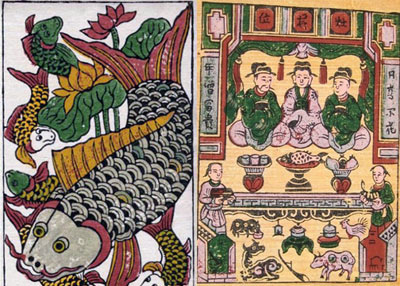
Every year, on the 23rd of December, the God of Kitchen will ride a carp to fly back to the heaven to report everything happening in the house of the owner with the King of the Heaven. And this is known as the custom of worshipping the God of Kitchen.
The Kitchen God is said to live only in the kitchen all year round and know everything in the house clearly. Moreover, the Kitchen God is also believed to bring the luck and good fortune to the family in the New Year. Therefore, to make the Kitchen God support and assist the family a lot of luck and good fortune in the New Year, people often celebrate the farewell ceremony for the Kitchen God before coming back to the heaven solemnly. Until noon on the 30th of December (Lunar Calendar) or the moment of New Year’ s Eve, The Kitchen God returns every house to continue his job of looking after the stove in the kitchen.
The “Kitchen God” Festival on the 23rd of December (Lunar Calendar) yearly
To know more about the custom of worshipping The Kitchen God in “God of Kitchen” Festival on the 23th of December (Lunar) by Vietnamese people, please read at:
https://elticenter.wordpress.com/2015/02/27/stories-the-custom-of-worshipping-the-kitchen-god-in-god-of-kitchen-festival-on-the-23th-of-december-lunar-calendar-by-vietnamese-people/
cung
By ELTiCenter

Stories, The custom of worshipping The Kitchen God in “God of Kitchen” Festival on the 23rd of December (Lunar Calendar) by Vietnamese people

The Kitchen God rides a carp to fly to heaven to report everything that happened in the family during that year to the King of Heaven. Until noon or the moment of New Year's Eve, the Kitchen God comes back to every house to continue the work of taking care of the stove in the kitchen.

The Kitchen God is said to live only in the kitchen all year round and know everything in the house clearly. Moreover, the Kitchen God is also believed to bring the luck and good fortune to the family in the New Year. Therefore, to make the Kitchen God support and assist the family a lot of luck and good fortune in the New Year, people often celebrate the farewell ceremony for the Kitchen God before coming back to the heaven solemnly.
To prepare for this farewell ceremony, people often buy two hats named “Kitchen God’ hats”. The hats for the two male Kitchen Gods have two wings that look like the wings of the dragon fly, but the hat for the female Kitchen God has no wings. Besides, the other offerings are three shirts made by paper, a carp (alive or made by paper, or made by a kind of votive paper called "storks fly and horses run").
20150209163501-ong-cong-ong-tao
Offerings for a complete “The Kitchen God” festival:
Trays with salt foods, sweets, betel and areca, wine, incense, candles, vases of fresh flowers, a plate of 5 fresh fruits (bananas, oranges, kumquat, grapefruit, finger citron), three sets of shirts, hats and shoes made by paper, votive money burnt for the dead and three live carps.
All those offerings are considered as the means to take the Kitchen Gods to the heaven to report to the King of Heaven.
tet-ong-cong-ong-tao-bai-cung-khan-tet-ong-tao-23-thang-chap2
The Kitchen God will report to the King of Heaven about the business and the behavior of each family. The ritual part including presenting the offerings, burning incense and praying usually takes place before 12pm. After that, people burn the hats and other offerings made by paper. Some people also release live fish into rivers, lakes, sea or wells, depending on the area they live in.
Vietnamese people attach much importance to this farewell ceremony for the Kitchen God because they consider this custom as a good occasion for them to express their sincere thanks to the Kitchen God for his taking care of everything in their family. It is believed that thanks to the Kitchen God, every member in a family has a good health and the family has a warm and full year with a good fortune. Hence, Vietnamese people always maintain this traditional custom from generation to generation.
To know more about the legends and meaning of the “God of Kitchen” Festival in Vietnam on December 23rd (Lunar), please read at:
https://elticenter.wordpress.com/2015/02/27/the-legends-and-meaning-of-the-god-of-kitchen-festival-in-vietnam-on-the-23rd-of-december-lunar-calendar/
By ELTiCenter
Một trong những người bạn thân của tôi từng bảo tôi rằng: “người tốt giàu lòng thương người” ở khắp muôn nơi. Chân thành mà nói, bạn tôi đã đúng.
Nếu bạn đang sống ở tỉnh Thái Nguyên, Việt Nam, có lẽ bạn sẽ biết chị. Chị tên là Nga, giảng viên của trường Cao Đẳng Cơ Khí Luyện Kim, Đại Học Thái Nguyên. Chị cũng là chủ cửa hàng siêu thị hoa Ly tại Bến Tượng, Thành Phố Thái Nguyên. Đặc biệt hơn, chị ấy còn là chủ tịch của nhóm từ thiện “THIỆN TÂM”.
5
Đến với siêu thị Hoa Ly của chị, khách hàng luôn hài lòng với những sản phẩm được cung cấp ở đây vì chị chỉ mang đến cho khách hàng của chị những sản phẩm hoa và rau quả sạch, an toàn, đã được kiểm duyệt chất lượng kĩ lưỡng bởi các cơ quan vệ sinh an toàn thực phẩm. Bên cạnh đó, siêu thị của chị cũng cung cấp các dịch vụ tổ chức sự kiện chuyên nghiệp như đám cưới hoặc tiệc sinh nhật. Chị và các nhân viên của chị đã luôn nỗ lực hết mình để thực hiện đúng phương châm “Xây dựng thương hiệu vì cuộc sống an toàn của người Việt”, vì vậy, khách hàng đã và đang đặt một niềm tin rất lớn vào các sản phẩm và dịch vụ được cung cấp bởi siêu thị của chị.
6
Bên cạnh sự nghiệp kinh doanh siêu thị hoa thành công của chị, chị cũng cống hiến cuộc đời của mình ở vai trò chủ tịch của nhóm từ thiện “THIỆN TÂM”. Với một tâm hồn giàu lòng trắc ẩn và sự thương cảm với những mảnh đời nghèo khổ và khuyết tật, chị đã kêu gọi và rủ các bạn của chị để thành lập một đội từ thiện. Sứ mệnh chính của đội từ thiện này là gây quĩ, khuyến khích mọi người trong cộng đồng chung tay góp sức cho những người có hoàn cảnh éo le ở các khu vực vùng sâu vùng xa trong tỉnh Thái Nguyên.
Điển hình là, nhóm từ thiện “THIỆN TÂM” của chị đã và đang mang đến rất nhiều sự hỗ trợ về vật chất và tinh thần đến người nghèo, đặc biệt là các bệnh nhận và học sinh nghèo. Gần đây nhất, nhóm từu thiện của chị đã kêu gọi và tập hợp sự hỗ trợ của cộng đồng để tặng học bổng bao gồm một chiếc máy tính xách tay mới, một chiếc xe đạp điện mới và hơn 20 triệu tiền mặt đến một em học sinh nghèo, khuyết tật nhưng có thành tích học tập đáng nể tên là Dương Đức Thắng.Thắng là sinh viên năm thứ hai tại trường Đại Học Công Nghệ Thông Tin và Truyền Thông Thái Nguyên. Gia đình Thắng ở huyện Đại Từ, tỉnh thái Nguyên và luôn thuộc diện hộ gia đình nghèo. Vượt qua sự khó khăn ấy, em là một trong những học sinh giỏi nhất ở trường đại học. Thật không may, em mắc căn bệnh ung thư xương quai hàm từ nhỏ. Em không có răng và không có xương quai hàm. Em ấy không thể cười như những học sinh bình thường khác và luôn gặp khó khăn trong ăn uống. Nhờ có sự hỗ trợ của nhóm từ thiện “THIỆN TÂM” do chị Nga làm chủ tịch, Thắng đã có một chiếc laptop em mơ ước bấy lâu để dùng trong việc học tập và một chiếc xe đạp điện để đi về nhà vào cuối tuần. (Nhà em cách trường 10 cây số.) Với số tiền mặt hơn 20 triệu Thắng và gia đình nhận được từ nhóm “THIỆN TÂM”, gia đình em đã có thể giảm bớt phần nào gánh nặng chi phí cho ca phẫu thuật sắp tới của em để tiếp tục điều trị bệnh ung thư xương quai hàm của em.

Trong ảnh, Chị Nga mặc áo dài màu cam và chị đang trao học bổng khuyến học bao gồm một chiếc laptop, một chiếc xe đạp điện và hơn 20 triệu đồng tiền mặt do nhóm từ thiện "THIỆN TÂM" của chị quyên góp và kêu gọi sự giúp đỡ của cộng đồng cho em Dương Đức Thắng, một sinh viên nghèo, khuyết tật nhưng có thành tích học tập xuất sắc tại trường Đại Học Cồng Nghệ Truyền Thông Thái Nguyên.
1506765_1526044264303146_1631411259065057256_n
Trong ảnh, chị Nga (người phụ nữ mặc áo đỏ) đang phân phát hàng trăm cuốn tập, quần áo và đồng phục áo khoác mùa đông mà nhóm từ thiện của chị đã tập hợp từ sự đóng góp của rất nhiều người trong cộng đồng để tặng cho hơn 100 em học sinh tiểu học tại trường tiểu học Thống nhất, xã Bình Long, huyện Võ Nhai vào ngày 26/11/2014. (Võ Nhai là một huyện vùng sâu vùng xa rất nghèo ở tình Thái Nguyên)
Chị Nga là một biểu tượng của người phụ nữ thành đạt trong thế kỉ 21 vì chị không chỉ có một sự nghiệp xuất sắc trong vai trò giảng viên, chủ siêu thị hoa, chủ tịch câu lạc bộ từ thiện mà còn là một người vợ tuyệt vời và một người mẹ chu đáo của hai con của chị.
Ở cơ quan của chị (Cao đẳng cơ khí luyện kim), bên cạnh công việc giảng dạy, chị cũng đảm nhận vai trò Phó Chủ Tịch Công Đoàn Trường và phụ trách các hoạt động của trường. Khi còn học phổ thông, chị từng là học sinh của lớp chuyên Toán ở trường THPT Chuyên Thái Nguyên. Trong cuộc sống thường ngày, chị yêu hoa và nghệ thuật múa. Chị từng bảo tôi rằng chị yêu hoa như thế nào thì chị yêu múa nhiều thế ấy. Trong cuộc thi cán bộ công đoàn giỏi ngành Công Thương được tổ chức ở Hà Nội vào tháng 06/2014, chị đã xuất sắc giành giải ba cho các phần thi cắm hoa, thuyết trình và biểu diễn năng khiếu là múa.
10443393_462493747218693_8916575172294554484_n (1)
Trong ảnh, chị Nga mặc áo dài màu xanh và chị đang biểu diễn tiết mục múa "Người đẹp Thái Nguyên" kết hợp với cắm hoa nghệ thuật tại Cuộc thi cán bộ công đoàn giỏi tại Hà Nội vào tháng 06/2014.
Về cuộc sống cá nhân, chị có một gia đình hạnh phúc với một người chồng tốt và hai đứa con rất đáng yêu. Mặc dù lịch trình công việc của chị rất bận rộn, chị dành rất nhiều thời gian chăm sóc tổ ấm bé nhỏ của mình. Chị luôn tạo mọi điều kiện thuận lợi nhất để hai con trai của chị đến trường, học thêm tiếng Anh và khiêu vũ thể thao ngoài giờ học tại các trung tâm Quốc Tế.
10653806_539959212805479_5796411257944722218_n
Em Minh, con trai cả của chị (Minh đứng ở bục số 1 trong ảnh). Minh năm nay 12 tuổi và em rất giỏi Tiếng Anh. Minh có thể giao tiếp tiếng Anh với người nước ngoài rất thành thạo. Em vừa đạt một huy chương vàng và một huy chương đồng tại giải Khiêu Vũ Thái Nguyên khép kín và mở rộng được tổ chức bởi tỉnh Thái Nguyên vào tháng 11/2014.
***
Mặc dù chị đã đạt được những thành công nhất định như vậy, chị không hề bằng lòng với bản thân mình và chị luôn nỗ lực hết mình để cống hiến cho xã hội. Chị không ngừng cải thiện chất lượng sản phẩm, dịch vụ và luôn ấp ủ mở rộng và phát triển các sản phẩm và dịch vụ tại siêu thị của chị với chất lượng tốt hơn nữa để tri ân khách hàng của mình. Chị cũng luôn cố gắng để duy trì và củng cố các hoạt động của nhóm từ thiện “THIỆN TÂM” để giúp đỡ được thêm nhiều mảnh đời bất hạnh trong xã hội. 
***
Năm nay tôi 21 tuổi và tôi là một phụ nữ rất trẻ. Tôi không biết là tôi sẽ nỗ lực bao nhiêu trong cuộc đời của mình để trở thành một người phụ nữ tốt, nhưng tấm gương của chị Nga thật sự tạo cho tôi một cảm hứng rất lớn để học hỏi nhiều hơn, làm việc tốt hơn và sống một đời đáng sống hơn. Sâu sắc trong tâm trí của tôi và có lẽ trong suy nghĩ của cả những người khác nữa, chị Nga là một người phụ nữ tài năng, thành công và rộng lượng. Chị là một sự kết hợp hoàn hảo giữa những nét truyền thống lẫn hiện đại của người phụ nữ Á Đông mà rất nhiều người phụ nữ khác có thể học hỏi nhiều từ chị.
Cá nhân tôi thì cho rằng, chị đang sống một cuộc sống thật ý nghĩa và chị chính là một bong hoa đẹp tô điểm cho cuộc đời của chị và cộng đồng xung quanh chị.
Thanh Hương
***
Bài viết này em viết tặng chị Nga - chủ Siêu Thị Hoa Ly tại Bến Tượng, thành phố Thái Nguyên, những người bạn trong nhóm từ thiện "THIỆN TÂM" của chị Nga và cũng là để tặng ông Melvyn Sakaguchi. Ông là Tiến sỹ Giáo dục , giám đốc chương trình Giáo Dục Quốc Tế Hawaii. Ông yêu đất nước, con người Việt Nam và ông luôn khuyến khích em viết về những người tốt, việc tốt ở Việt Nam.

Vietnamese Women, The owner of a flower shop in Thai Nguyen, Vietnam and her passion of charity job

One of my close friends used to tell me that “good people with philanthropy” are everywhere. Honestly, she is right!
If you are living in Thai Nguyen City, Vietnam, you may know this very kind woman. She is Mrs. Nga and she works as a teacher at College of metallurgy engineering, Thai Nguyen University. Besides, she is the owner of a flower shop and also the leader of a charity club called “THIỆN TÂM” (meaning: KINDNESS).
5
About her flower shop, customers are always satisfied with the products provided by the shop because she only provides her customers with safe flowers, vegetables and fruits that have been censored carefully by food safety agency. In addition, she also gives her customers the service of organizing professional events like wedding or birthday party. That she and her colleagues make all efforts to carry out the slogan of her shop - “Building a brand for safe life of Vietnamese people” has gained the great trust from all her customers.
6
In addition to her successful career as the owner of a flower shop, she also dedicates her life as the leader of a charity job known as “THIỆN TÂM” (KINDNESS). With her great compassion and philanthropy for the poor and the disabled, she called and invited her friends to establish a team whose main mission is to raise fund and encourage people in the community to join hands to help the disadvantaged at remote areas in Thai Nguyen province.  For instance, her charity group has given many spiritual and material supports to many poor patients and students. The most recent, her group called and gathered the help of the community to give a new lap top, a new Electric Bicycle and more than 20 million VND in cash for a poor but excellent student named “Duong Duc Thang”. Thang is a second year student at University of Information and Communication Technology (ICTU), Thai Nguyen City. He comes from a very poor family in Phu Binh district, Thai Nguyen and he is one of the most excellent students at ICTU. Unfortunately, Thang has a disease of “jaw - bone cancer”; therefore, he has no teeth, no jaw bone. He can never smile like other normal students and he has a lot of difficulties in eating. Thanks to the support of Mrs. Nga’ s charity group, Thang has a new laptop to use for his study and he has a new electric bike to return his 10-kilometer-far-from-school house every weekends. With the amount of money in cash Thang received, his family will be able to reduce the burden for Thang’s next surgeon to cure his disease of jaw bone cancer..

Mrs Nga - the woman in orange Vietnamese Dress gave a new lap top, a new Electric Bicycle and more than 20 million VND in cash to a poor but excellent student named “Dương Đức Thắng” at ICTU, TNU.
1506765_1526044264303146_1631411259065057256_n
In the photo, Mrs. Nga (the woman in red) is delivering hundreds of notebooks, clothes and warm winter coat uniform that her group collected from many people in the community to more than 100 poor primary students at Thong Nhat primary school, Binh Long village, Vo Nhai district on November 26th, 2914. (Vo Nhai is a very poor remote district in Thai Nguyen province).
Mrs. Nga is a symbol of a successful woman in the 21st century because she not only has a good career as a teacher, a flower shop owner, a leader of a charity group but also a wonderful wife and a great mother of two children.
At her office (College of metallurgy engineering), besides teaching job, she works as Vice Union President who is responsible for various activities of her school. At high school, she used to be a student in a gifted class for students who had good capacity of Maths. In daily life, she is interested in flowers and dancing. She once told me that she loves flowers as much as dancing. At the contest for excellent union officials held in Ha Noi in June, 2014, Mrs. Nga won the third prize for her performances of arranging flowers, presentation and dancing.
10443393_462493747218693_8916575172294554484_n
Mrs. Nga - the woman in blue Vietnamese Dress is completing her performance of dancing combining with arranging flowers at the contest for excellent union officials held in Ha Noi in June, 2014.
About her personal life, she has a happy family with a kind husband and two lovely children. Despite her busy schedule, she spends a lot of time taking care of her family. She creates all the best conditions for her two sons to go to school, learn English and dance sport at international centers.
10653806_539959212805479_5796411257944722218_n
Minh, her first son - the little boy in the middle of the photo (12 years-old) is very good at English. Minh can communicate very well with foreigners in English language. He has just won the gold medal and the bronze medal in the open and close dancing contest held by Thai Nguyen province in November, 2014.
***
In spite of her successful career, she is never satisfied with herself and she always tries her best to dedicate to the society. She continually improves the quality of products provided by her flower shop to expand and develop the products and services at her shop. In addition, she also tries to maintain and reinforce the activities of her charity group so that more and more poor and disabled people will be supported.
This year I am 21 years old and I am still a very young woman. I am not sure how much efforts I will make during my lifetime to become a good woman, but the image of Mrs. Nga completely inspires me a lot to learn better, work better and live better. Deeply in my mind and maybe many others’, Mrs. Nga is a talent, successful and generous woman. She has both the traditional and modern characteristics of the Asian women that many women can learn from her.
Personally, she is LIVING meaningfully and she is a very beautiful flower that makes her life and community more and more beautiful.
By Thanh Huong
***
This post is written as a gift to Mrs. Nga - the owner of Flower Shop at Ben Tuong, Thai Nguyen City and her friends in charity group "KINDNESS". This is also a gift I would like to give to Ed.D. Melvyn Sakaguchi ­ Director of Hawaii International Education Program. He loves Vietnam country and Vietnamese people and he always encourages me to write about good Vietnamese people.